Sunday, November 14, 2010

This just in

Recent happenings in and around Akune

The debut of Rider Shochu, shochu made with potatoes harvested by touring motorcyclists that stayed at Akune STAYtion, the NPO where I volunteer


Reception


“Carmen”, the famous opera came to Tsurukawauchi Junior high school. If you look close, you can see a few of my students breaking legs on the big stage


Miki’s birthday party


Pre-river rafting in Hitoyoshi, Kumamoto with Zak from Nagashima


Fireworks show post-river rafting in Yatsushiro, Kumamoto


Yatsushiro manhole cover, for Dad


I woke up the morning after river rafting and unconsciously voice my craving for a bagel. My friend took us to the bagel shop down the street; the wonders of living in a slightly large city, I thought


Greetings from a noticeably chillier Akune.

After an exciting and crowded English conversation class this past Thursday evening, I paid a long-overdue visit to one of my favourite restaurants in town. On the east side of Route 3 (a national interstate that runs throughout the island of Kyushu) about fifty meters south of Akune station is Wakana. Every evening of the week except Sundays, the entrance of Wakana glows in the light of its red lantern and the reflection off of the hideously balding head of the loud, charismatic co-owner, Master. If you take a step inside to what some might call a whole in the wall, Okaa-san (Mama), greets you warmly as you find your way to an open seat at the bar, probably next to Master who has come inside to wet his whistle. Sure, there is a menu, but there is nothing like leaving it Okaa-san, who has been pleasing hungry customers for longer than I have been able to chew.
A night at Wakana, usually starts with a sweet stewed vegetable appetizer (daikon radish, turnips and the like) and continues with an endless assortment of fried fish, grilled skewers of chicken, Master’s immaculately prepared sashimi and other delights. With a trained eye Okaa-san asks if you are ready to round off your meal with some piping-hot miso soup and a bowl of steamy white rice; I am always thankful when she asks before I have eaten too much. This Friday, at just the right time, the miso soup and rice came out. I closed my eyes and slurped the soup. I had my rice bowl in my hand and with one look at the rice I noticed something was different; the rice was shimmering.

Mama said, with noticeable pride, “This is shinmai [新米, new rice] from Nagashima”, referring to the island just north of Akune, ”tastes great, right?”

Japanese shinmai is magic. It is fragrant and has a deep savory taste locked inside every glutinous grain. When cooked well, it glistens. Each bite is unspeakably satisfying. You may be thinking to yourself, ‘Can one really use those words to describe white rice?’ Well, yes, one certainly can. New Japanese rice, that has sustained the Japanese soul for thousands of year, is truly something to behold. And this year I had the opportunity to understand what kind work it takes to get that very rice from the tanbo (rice field) to the table.

A few months ago, one of my Japanese English Teachers (JTE) from Akune Elementary, Tashiro-sensei, told me that his family will be harvesting rice at the end of the month and if I were interested my help would be welcome. The work would include cutting the rice stalks with a sickle, organizing the bunches of stalks, hanging them to dry on take-uma, literally bamboo horses, and heartily celebrating in the evening with all of the family members. I was very happy that Tashiro-sensei decided to propose the idea to me and, in retrospect, am duly grateful for the experience.

After a short drive south on Route 3 we, Tashiro-sensei, his wife and I, arrived at the family residence in Satsuma-sendai. When we arrived we exchanged salutations with the matriarch of the house, Tashiro-sensei’s Obaa-san, Grandmother, a pleasant elderly woman who apparently has a knack for raising delicious vegetables; our short exchange made me think that her bright smile never leaves her face. Then it was off to the rice fields to start the day’s work. Our goal for the day was to cut, gather and prepare bundles of rice stalks to be cured before processing. Those getting their hands and feet dirty that day, were the Fathers, Mothers, aunts, uncles, and cousins (and one foreign friend) of Tashiro-sensei’s, all of whom were eager to give me pointers on the various tasks that make inekari (rice harvesting) possible.

Inekari, stacking bunches of rice stalks


It takes the better part of six months for rice to grow and fully mature before it is harvested. Before the rainy season hits Japan in the early summer, the rice paddies are flooded and dotted with thousands of baby rice stalks. By the end of the summer the stalks reach almost one meter in height and show a most vibrant green. Just before the harvest, however, the rice fields transform into a humble gold and the stalks’ once proud posture crumbles under the weight of the rice grains; Tashiro-sensei told me that the rice is bowing to the Earth in respect.

Drying stalks


Tashiro-sensei counting the grains to see if this year’s harvest met his late-Grandfather’s benchmark of 130 grains. This year was a pretty good harvest


English listening CD, this one has been repelling crows and many other of rice’s airborne enemies


When the rice stalks are ready to harvest the paddies have dried mostly and are able to accept the weight of harvesters’ feet and even heavy-duty machinery. In the days of old, and in a few rare locations now, rice farmers used to cut the stalks with sickles and bundle up the bunches with the dried, fallen fronds. On the day that I was in the fields, I cut a few stalks with a sickle; according to Tashiro-sensei, it was for the experience, because I really don’t want to do a whole field like that. The remaining rice was dealt with a machine. It was a phenomenal machine. The eldest of the family would walk it systematically up and down the lines of stalks and the machine would cut and bundle the stalks as it went along. If that wasn’t enough, there was even a mechanism that would tie off the bunched stalks and toss them aside with the precision of, well, a piece of specialized agricultural equipment. This left only one job, which happens to be the most important step in Japanese rice harvesting.

It is my understanding that Japanese rice would not be the same if were not for the last step in the harvesting process. I am speaking, of course, of the sun drying process. After the elders built the take-uma (remember? bamboo horse), resembling a drying rack, we gathered bunches of stalks, separated them in the center and draped them on it in a criss-cross fashion. Depending on the given family’s practice, the stalks will then be left to dry for one to three weeks, sometimes up to one month. But I have a feeling, a scientific hunch that a lot more than drying occurs on top of the take-uma. For instance, when you take a steak of the grill and cut into it right away, what happens? Exactly. All of the savory juices that are supposed to dance on your taste buds flow out on to your plate. That is why the culinary world practices the oft looked-over art of resting. Resting: the few precious minutes of doing nothing to your cooked hunk of meat, which allow all of the juices to redistribute throughout it evenly. The drying process for rice, I believe, is carried out with this same intention. Instead of processing the stalks right away, a few weeks are given for the stalks to, one, dry gently and completely in the suns rays and, two, to allow the nutrients still in the stalks to reach the grains. The proof is in the pudding, rice pudding, that is.

Super sickle


Throughout the morning and most of the afternoon I joined the inekari cadence of the Tashiro family, sweating along side cousins, uncles as well as other friends from the area. Just as we all started grunting and groaning from the day’s work the last bunch of stalks were hung on the take-uma and as soon as it started, the inekari for the year was over. I joined the rest of the family and huddled around the cooler to enjoy a nice cold tea while the youngest cousin had ice repeatedly poured down the back of his one piece work suit; cousinly love shows itself in the funniest ways. Obaa-san welcomed us back to the house and was overjoyed at the gift we brought her back from the field, a dead mamushi, Japanese poisonous pit viper. Apparently she makes a mean soup with it.

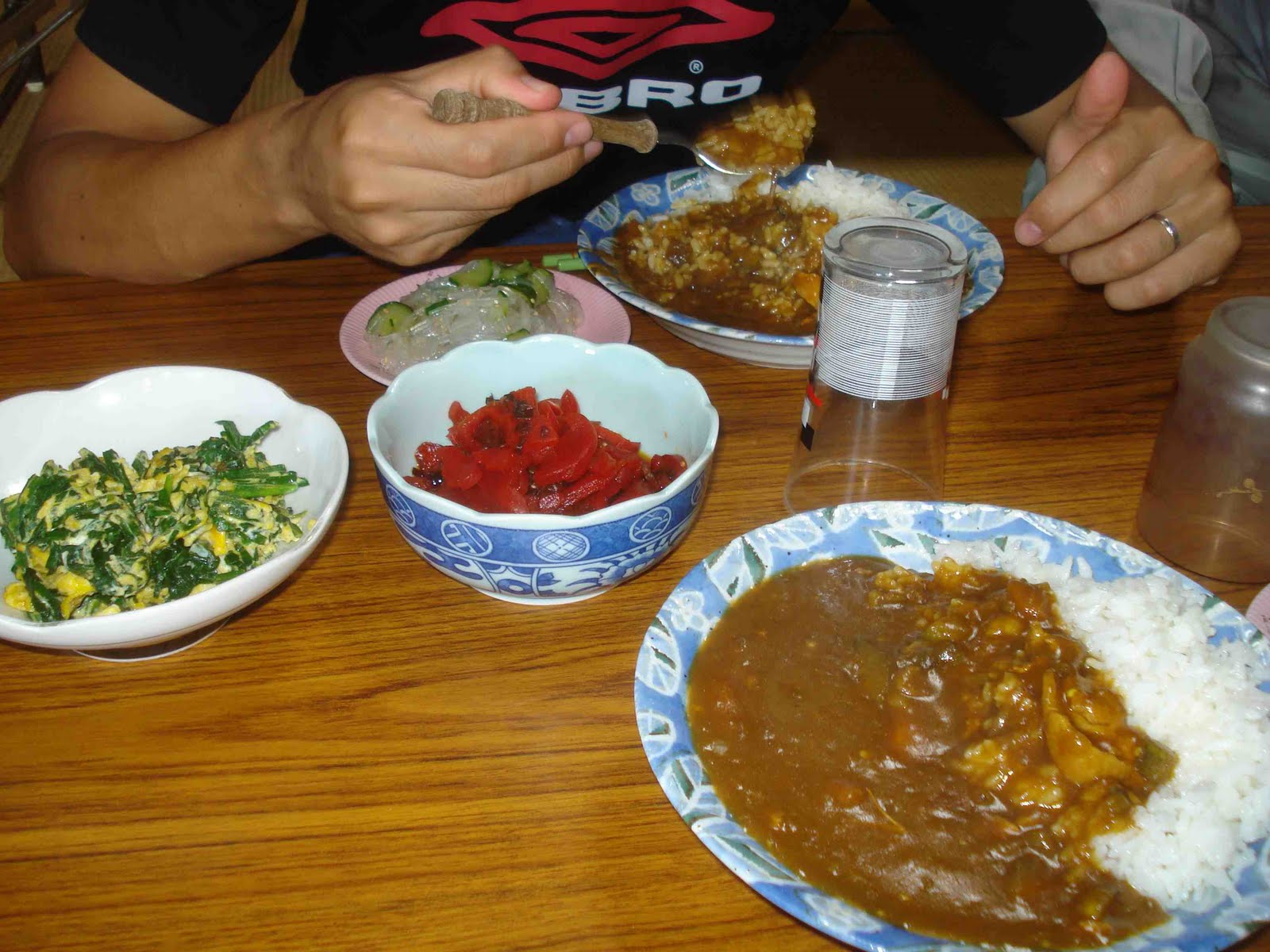
Super lunch


Super nap


Super staff


After we returned from the onsen to relieve our tired muscles, the real work started, partying with the Tashiro family. There was eating. Yes. There was a barbeque. Sure. And I mustn’t forget the mess of boisterous drinking. The highlight, however, was the arm-wrestling match. One second I was pouring drinks for the elders and the next thing I know I was locking hands with them, mere centimeters away from their grinning, flushed faces. I was never the strongest boy in class, or the strongest Ramras for that matter. I am pleased and proud to report, however, that I am the strongest Tashiro. That’s right. One-by-one, my opponents fell to my intoxicated offense. I left everyone in the dust. It was honestly a riot. In return for my efforts I was given a gift: I was presented with a name; I was inducted into the family. This, I took it, was a pretty big deal. My name for the rest of the night was Kensaburo, which roughly translates to the third son. By the end of the night, Asher, the foreigner who came to help with inekari, was long forgotten. Instead, Kensaburo was wished a good night and invited back anytime, for the door to Obaa-san’s house would always be open. There was no talk of am arm wrestling rematch.

The Tashiro and Ishidzuka (the other family branch)


They said I looked cool when I was pouring


I try my best


Another sorry opponent


About one week ago, I visited Tashiro-sensei’s house-literally five doors down from me-and received a handsome portion of the Tashiro family’s best shinmai. I have been enjoying every grain and basking in the glow that emanates from my rice bowl. With every bite I think of my inekari experience and recall this Japanese proverb:

米一粒汗一粒, kome hitotsubu, ase hitotsubu

A grain of rice, a bead of sweat.

Until next time.

Sunday, October 17, 2010

Trust me

Greetings from Akune, anxious readers (I know some of you are out there, somewhere).

One early morning in the late summer


It goes without saying that this is my first update in a while, my first entry, in fact, since the new school term has started. Yes, second term is in full swing and my job is getting easier with each passing day. I mean this in a number of ways. For one, the relationships between my fellow teachers and students, who number about twenty and five hundred and twenty, respectively, are becoming more solidified. Despite the fact that I still hear gasps and induce body-jolting flinches when walking through the halls, I feel that the students I teach are becoming more accustomed to my presence; the only thing that disturbs me is that some of my kids still insist on calling me by the name of the previous teacher. As for my fellow teachers, both at the elementary and junior high school level, I think our communication has improved ten fold, and by improved I mean that I asked the board of education to demand that a lesson plan be sent at least one day before class. This new system, which the teachers have graciously chosen to abide by is without question making the flow and content of classes a lot better. Now all we need is the students to catch on. Working out these logistics has certainly made my job easier. Nothing, however, make my teaching in an open-air school more manageable than a five-degree drop in the temperature.

It was about four weeks ago when the Autumnal Equinox occurred in Japan. This is a fairly special and celebrated holiday in Japan: it signifies the start of the fall season; it is said to be the night when the full moon shines the brightest, sparking all sorts of moon-watching events; and it is a time when agriculturalists, namely rice farmers, implore Mother Nature in hopes for a successful harvest. On the night of the equinox the moon was indeed shining brilliantly and when I awoke the next morning a very calm, cool breeze had taken over my apartment. It was as if the Japanese calendar had come into just to tell me, “Trust me, when I say it’s time far autumn, it’s time.”

When I wrote my last entry, I believe I was still sleeping atop two ice packs, my sacred havens of icy relief, with the AC on full blast. Indeed, I spent the days of late August and most of September struggling not to sacrifice excess body fluid and battling to stay hydrated while doing, well, anything from cooking dinner in the evening to folding up my bedding in the morning before work. Knowing that the twenty-four hour sauna that is late summer whether would end soon, I trudged along with my daily routine as usual, paying extra visits to the air-conditioned library in the middle of town.

Everyday of summer vacation seemed to run together (mind you, when I say summer vacation it is not the same as in the States where teachers and students alike are not at school (teaching staff are at school everyday during the summer and students, for the most part, are at school involved in some sort of club activity (this is most certainly the same for all civil servants including the board of education, which yours truly is a proud member))). That was until the day I decided to get a haircut. I saddled up in the barber chair at my barber, Sunabata, and received, as always, a pleasurable cut, shampoo and straight razor shave. About half way through my shave I got a call from Captain Matsunaga.

“Asher, another one just arrived.”
“…”
“It’s a yacht. They’re from Holland, and what’s more, they speak great Japanese”
“Oh, so I guess you don’t need me to come, right?” I said jokingly.
“You gotta be kidding. Come meet these guys at Harmonican as soon as you can.”

For the next ten days, I had the pleasure of sharing the company of Jaap and Marijke, a wonderful married couple from Holland that have been living and sailing around Japan for upwards of ten years. It was a blessing that they spoke such good Japanese. For one, they could go wherever they pleased without any trouble. More than that, though, was the fact that they could connect with the Captain and all of the Harmonican crew. In comparison to the yachters that have come before, the connection that the Akune natives made with Jaap and Marijke was far more solidified, at least in the aspect of communication and mutual understanding. What I can say for sure, though, is that Jaap and Marijke’s end off was done with much more forethought that the yachters who came before them. One word: streamers.

Jaap and Marijke


Goodbye Jaap Marijke


A few weeks into September the junior high schools started having their Sports Festivals. Sports festivals have been a part of the Japanese education system for decades and are taken quite seriously in my city and from what I gather all over Japan. Every year it’s the same: the White Team versus the Red Team. Teams are awarded points for superlative performance in sporting events, ranging from running relays to tug-o-war, and from obstacle courses and beanbag tosses, and sportsmanship. After witnessing both junior high and elementary school Sports Festivals, I can say with full confidence that the elementary schools bring the fire like no one else; you’d be surprised at the game of a Japanese first-grader.

Akune Junior high school’s Sports Festival, rain or shine


The Essassa dance


One thing that is very special about Akune’s elementary Sports Festivals is the tradition of welcoming back graduates that have turned 50-years old. Thus, the 50-year old team stands as one of the most anticipated events of elementary schools all over the city, and rightfully so. I witnessed the glory of the 50-year old team for the first time last year, mere months after starting my position in Akune. I was overwhelmed by the whole idea of Sports Festival and did not initially register the significance of the 50-year old team’s presence. That was until I attended this years elementary Sports Festival.

Sports day bento


Soran-bushi (Soran dance)


Tsurukawauchi Junior high school, Sports Festival


The torrential rains in the morning, although expected, shuttered the play fields’ white tents and all of the family members that sat under them, anxiously watching the sky, searching for any sign of a brake in the clouds. When the clouds finally broke at around half past ten, I was already on my way to my third school of the day; I would go on to visit six schools in total. To my disappointment, the dance that I was planning on seeing at Yamashita Elementary had been rescheduled. I missed the dance by mere minutes. However, once I was seated under the tent reserved for visitors and served a piping hot cup of green tea, the 50-year old team made their grand entrance. It was powerful. It was triumphant. It was all one could expect from a group of people that have been gathered from across the country for a 30-some-year reunion. The play field turned slightly somber when memorial speeches were given to those of the graduating class that had, unfortunately passed away. It is without a doubt, though, that the most memorable portion of the 50-year old team’s presentation was when the teachers of the 50-year old team made their appearance and received a bouquet of flowers and very heartfelt greetings from their former students. The look of awe on the faces of the teachers was something I might not have noticed last year, and will remember for a long time.

Speaking of Sports Festivals and old people, as I was watching the Okawa Junior high school sports festival I was approached by a man, Mr. Kawabata, who asked me if drank alcohol. I know, this may sound weird, but it was not the first time someone has struck up a conversation with that question. With some patience and tactful questions I found out that Mr. Kawabata was trying to invite me the Okawa community center’s Respect for the Elderly Day party. I was glad to oblige. What I assumed to be a very sleepy and short engagement turned out to be a hilarious event in honor of the community’s elderly, at the begin of which I was asked to give a short speech, and a celebration of the arts, which I was asked last minute to participate in. In the end I was glad I answered Mr. Kawabata’s question correctly, “Yes, I drink.”

The Hanya-bushi


I am indeed grateful for the encounters of my late summer and early fall. With these memorable experiences in mind I would like to leave you with a Japanese proverb that is often used in the context of tea ceremony and the concept of transience:

一期一会 (ichi-go, ichi-e)
Literally translated, this four-character idiomatic phrase means, one time, one meeting. There are numerous other translations for this phrase, but I will chose not to take the liberty and allow you the pleasure.

Until next time.
Summer vegetable dinner: pumpkin and chicken dumpling soup; okra; and goya stir-fry


Niku-jaga (braised beef) party


Raisin bread…from my rice cooker, no joke


Coming soon

Wednesday, August 25, 2010

Awesome: Tokyo Orientation, homecoming and the color of the ocean

Tokyo Orientation 2010, Welcome Ceremony


I flew out of Kagoshima on the first flight to Haneda Airport on the 24th of July. That Friday was the beginning of the Japanese Exchange and Teaching Programme’s (JET’s) 2010 Tokyo Orientation. After applying to participate as an assistant for the orientation a few months prior, I was offered the position and accepted at once to step up to this unique opportunity. This year an expected 700 Assistant Language Teachers (ALTs) and Coordinators of International Relations (CIRs) were to commence their training for the upcoming year (and for some years) in Japan. The orientation is hosted at Keio Plaza Hotel, which is in the center of Shinjuku ward, known to have some of the busiest human traffic in the world. It had been nearly six months since the last time I visited Tokyo; it still lives up to its gigantic reputation, on all levels.

My roommate for the Orientation, Galileo


Unforgettable tiramisu cake from the Italian restaurant in the basement of Keio Plaza


For the next four days I was buzzed around Keio Plaza in a suit, toting a map of the hotel’s labyrinth of corridors, guiding new JETs to presentation rooms, internet and hospitality centers and answering any questions I could about living in Japan. A few months before the orientation I was asked to present along side two other orientation assistants about food, dining and cooking in Japan. I was thrilled at the opportunity to put together an approachable perspective on cooking with Japanese ingredients at home. The looks of the faces of my two presentation partners was priceless when the moment of truth came; the venue was packed with more than 200 people in chairs and even more standing.

The audience for "Food, Eating and Dining in Japan"


Needless to say, I was glad to have had the chance to participate in this year’s Tokyo Orientation. Not only was I able to interact with the new JETs from all around the world, but I also had the pleasure of sharing the company of other current JETs representing all of Japan’s 47 prefectures. Hours after concluding the orientation I was on a direct flight to Seattle; family and friends were waiting.

Family


I had not smelled the crisp northwest air, gazed at the Seattle skyline or sat in my dining room in exactly 368 days. In all honest truth, I expected it to be a much longer time before I was once again surrounded by all of these things, before I came back home. Maybe it was the fact that it had been almost exactly a year, or perhaps it was the presence of Grama Selma, Chloe, Yehuda and nearly twenty other family members. Either way, something made me feel a heightened sense of homecoming. I knew it was something special. I knew I had to soak it up. Luckily, the first seven days of my visit were string of unparalleled dinners, parties and family get-togethers that I will not soon forget.

Grama and her girls


The big new family


Birthday on the “Fun-der-barge”, Funderbirthday


Cousins


Falafel night


Out of all the family members who came to Seattle I was the last one to leave, and yet I still felt rushed. Just when my body had adjusted to the abnormally cool Seattle summer climate I was on a plane again to face to the crippling heat and humidity of Akune. Fortunately, school was still out of session and I could spend the remaining weeks of summer vacation in the air-conditioned city hall as opposed to the open-air school staff room.

Herbage


Goya, Nigauri, Sour melon


When it is 33 degrees centigrade outside and 35 in my apartment, all I want to do is swim in the ocean. To my great disappointment, though, I cannot swim. The reason, of course, is that we are in the middle of jellyfish season and as a result the ocean shores have been closed off.

“I need to swim. Where can I swim?” I asked Captain Matsunaga, dreading the potential of spending the rest of the summer without as much as a dip in the ocean.
“Well, we have to go to Koshiki-jima, of course”, said the Captain, nodding as if knowing all the answers, “Are you free on Sunday? Let’s go on Sunday. I’m going to show you the real color of the ocean.”

I woke up on Sunday and it was still pitch black. I drove to A-Z (a store similar to Costco or Sam’s Club) to meet the Captain and shop for the essentials we would need that day: water; sauce for the noodles the Captain had prepared the night before; and peanuts. Before heading to Akasegawa port where Captain Matsunaga’s boat is moored, we stopped at Harmonican, roused Juno (the Captain daughter) from sleep and raided the icebox. While the ocean was still calm, we loaded up the Kamome-maru (the yacht) with our gear, rigged jib and raised the main sail. Seconds later the sun rose.

The Kamome-maru and crew


Captain


Second mate


The round trip journey to Koshiki-jima was eight hours, plenty of time to troll for fish, eat peanuts and soak up some PTRs (prime time rays). After we passed Akune Oshima we let out the trolling rig and waited anxiously for a catch; I waited for the color of the ocean to change. In a few hours with the help of a trusty motor and slight northwestern wind we were cruising over an indescribably navy blue ocean; the sun penetrated meters down into the warm summer sea. When we approached a floating pile of garbage and wood Enokida-san, one of our crew, said, “There are fish under there, watch.” As soon as the trolling rig passed the drift, the slack rubber band snapped taut. I grabbed the line and slowly reeled in our catch. I gazed into the ocean and saw a flash of vibrant blue and yellow, and another; we had just hooked two shiira, or mahi mahi. I pulled them up on top the stern of the boat. The blue color of the fish was so alive. I noticed that one of the fish had been hooked in the cheek and was losing a lot of blood. The fish convulsed with astounding strength, showering the deck and its crew with thick mahi mahi blood. We all roared with laughter and bewilderment. Moments later I had my first taste of mahi mahi, my first sashimi breakfast.

Shiira


Destination Koshiki-jima


At the moment I thought I could not take anymore of the rocking boat we dropped anchor at Koshiki-jima; it was time to swim. The visibility in the water was amazing and the colors of the fish were so vivid. Before I knew it I had been swimming for two hours and it was time for lunch. Under the shade of the main sail our crew of three shared a lunch of somen (thin noodles) in ice water, mahi mahi sashimi and fresh picked plum tomatoes from the Captains garden. After a post-lunch dip, we raised the main sail again and headed back for Akune. We would catch five more fish on our way home and that night I ate like a king.

Shiira salted and drying


I would like to leave you with a proverb that is appropriate for the nearly 14-hour journey to Koshiki-jima:

早起きは三文の得
The early bird gets the worm.