Sunday, February 7, 2010

Ding

Hello all and a long overdue happy new year.

I have been in transit for over a month. It all started with my 700 a.m. bus ride to Kagoshima airport on the morning of December 24th. That bus ride became the first two hours of what would end up being a 34-hour day of traveling. Two buses, three planes and a nesher (shared taxi cab) later, I reached my destination, the Machon Ya’akov Yeshiva in Har Nof, Jerusalem, at 300 a.m. That is where I met the first of three new brothers, Ronnie. I was escorted to the top floor of the yeshiva and into a room where I finally stopped moving and started sleeping. It was a joy to be back in Israel.

The next two weeks in Israel were phenomenal. It had been nearly six months since I had seen my parents and almost two years since I had seen my Uncles and Aunts. Needless to say, I was excited to reunite and rejoice with my family. Despite the high tensions that any family experiences before a wedding, I was calmed by the presence of my family and pleasantly stimulated by the sights, sounds and smells of Tel-Aviv and Jerusalem.

Having just spent a solid 5 months Japan, I was confronted with certain aspects of Israeli society that just did not compute. As I rode in my Uncle Marshal’s car, walked down the narrow passage ways of markets and soaked up the atmosphere of restaurants I was constantly asking myself questions: Why don’t Israelis wait in line? Why is everyone so loud? And how on Earth do you think I could possibly eat this enormous portion of food you just served me without the slightest trace of a smile on your face? I was a victim of Israeli culture shock. Luckily it was a long awaited, exciting and delicious culture shock.

After spending a few days in Tel Aviv with Uncle Marsh, the family moved camp to Jerusalem. From our centrally located hotel at the top of Ben Yehudah street, my parents and I spent the few days before the wedding touring the Old City, shopping at the market, a truly thrilling experience in itself, and thoroughly enjoying the hotel breakfast. It was a special time that I shared with my parents, for two reasons. First, I had not seen them in a long time so there was a lot of catching up to do. Also, it was both my parents and my second time in Israel. That was something I thought was unique about this past trip.

I was personally thrilled at the opportunity to come back to Israel and not be tethered to the strict time schedule of a Birthright-Israel tour. I loved my Birthright trip, believe me, but this time I was free of the long bus rides, the amorous atmosphere of the hotel stays and Long Island Jews who were always late to get back on the bus. I finally had the time to sit down and soak up the atmosphere, rather than take as many pictures as I could before joining the herd back on the bus. In the few days before the wedding I was able to get to know the Ben Yehuda neighborhood, the Market and meet Chloe’s friends from Neve Yrushalayim, my friend Becca from high school and, of course, Yehuda and his family.

“OK, Ash. Let’s go to Chloe’s wedding.”
This is what my Dad said as he and I walked out of our third floor hotel room dressed in black suits with matching white pocket squares and pitch black kippot. I am surprised that my kippa stayed on the whole night considering how much and wildly I danced. How could I not? It was my sister’s wedding. Chloe was such a beautiful bride. I remember taking pictures with her right before the wedding. There were children standing right beside us, children who had never seen a bride before. I hope they know how lucky they were to have been able to seen my sister. She was absolutely stunning and Yehuda, with his pearl white tie and crisp black hat, was as sharp as he could have been.

Having not seen each other for a week before the wedding ceremony, the moment when Yehuda came to see Chloe at the beginning of the ceremony sent tears streaming down their faces, right past their enormous smiles. I was put at ease by the extremely high emotions of the wedding. The crowded chuppah, the resonating tones of the Rabbis blessing and the rambunctious dancing were each as soothing as they were awe-inspiring. It was an unforgettable wedding. Oh, the simcha.

I was glad the buzz from the wedding lasted as long as it did or else I don’t think I would have been able to survive my 48-hour trip home including a ten-hour in Rome on the way. When I arrived in Fumicino airport I went straight to the central train station and hoped on a tour bus and suddenly felt an overwhelming wave of nostalgia from my Birthright days wash over me. I had a limited amount of time to soak up the centuries of art, architecture, fashion and gelato that Rome has to offer. For how meager my time was in Italy I will remember many things about Rome: the tour buses are awesome; the neck ties are bright, silk and not that expensive; the espresso is to die for and cheap; the fountains are extravagant; the Jewish quarter is staggeringly beautiful; the kosher restaurants are underwhelming; and if you hold your camera up in the air, close your eyes and shoot you will get a great shot.

My return to Akune was comforting. It was a relief to be back home in the countryside. However, I only had a few days to shake my jetlag and readjust to the rhythm of the city before I had to help Laura, my very first and long awaited visitor from the West, do the same. Laura was a (slightly cold) trooper for the whole trip. I did my best to show her all that Akune has to offer in terms of sights, good eats, long walks in the mountains and through the neighborhoods of my schools. I even had the privilege to introduce Laura to one of my favourite schools in the mountains (of which there are only two and they are both my favourite). On two of the three weekends that Laura was in Kagoshima we took a trip to Kagoshima city to get a feel of the big city, a look at an art museum, a taste of Indian food and a Japanese business hotel experience.

It has been a slow weekend and a cold one at that. Having heard from a number of Akune natives, this winter has been especially frigid. Luckily the Captain has spent numerous days doing hard manual to make his very own 竹火バー (Bamboo fire pit/bar) in his own backyard. Thanks to the Captain and his devotion to thrive as a macho man should-outside, huddled around a roaring fire, grilling fish, eating Dutch oven-cooked meals and drinking booze out of bamboo cups-I have spent a warm weekend in an otherwise cold countryside. Reflecting on my wintry woes I am reminded of this Japanese proverb:

冬来たりなば春遠からじ (fuyukitarinaba harutookaraji)
When winter is at its worst, can spring be far behind?

Until next time.


I am not hitting this woman, I am just making mochi (pounded rice cakes) for the new year. Check it out . . .


See? Harmless, delicious mochi with anko (bean paste) filling, still warm.


There is something about the sunset over the Mediterranean that is more vibrant than anywhere else in the world. You should have seen the sunset in Jerusalem at Shabbat.


Smoked saba (mackerel) in Shuk ha'Carmel (Carmel Market) in Tel-Aviv. This fish was so succulent, I had to buy some. I ended up buying too much, oops.


Chloe and Asher (and shakshuka, delicious baked tomato, onion, eggplant and mushroom dish) reunite. Yeah.


Ah. Israeli breakfast.


The Western Wall at the end of the family's Old City tour.


The shuk in Jerusalem on a Friday morning. Preparation for Shabbat is makes for a cut throat experience in the market alley ways.


Dad and me in the taxi to the wedding, suited and booted.


A real bride.


Richard, Yehuda and Dad


The Abbos, officially, with enough simcha for a lifetime.


My new brother.


Brother and sister


My new brothers, Jonathan and Ronnie.


Rome, just point and shoot.


At the tail end of my loop around the Colleseum.


Tempio Maggiore.


Ties. I got the yellow one.


I threw my last 1 shekel piece in the Trevi fountain.


Welcome to Akune.


Kagoshima Municipal Art Museum.


Kagoshima manju.


Laura's debut at Ozaki Elementary.


Bird watching at Ozaki Elementary.


Plum blossoms.

Finally, I had a customer to share my cooking with:

Salt sured salmon, Satsuma sweet potato and enoki mushroom with pickled plum and sesame seed.


Grilled iwashi (sardine), with bok choy and shiitake saute.


Akune's famous bontan.

Wednesday, December 23, 2009

Something Amazing

I witnessed something amazing. I woke up early the other morning to the sound of rain, the clear sound of rain pattering on the thin, tin-like roof of my apartment. I was up early for the annual grand gate gold tournament in Akune. As I expected, not ten minutes after I rose from the warm depths of my futon did I receive a call from my advisor Momokita-sensei informing me that the gate-golf tournament had been cancelled, do to the rain, of course. Too bad, I thought to myself, tired and shivering in my cold apartment.

I decided not to go back to sleep. Instead I whipped up a quick breakfast of a left over tofu omelet that I ordered at Harmonican the night before. Breakfast is what keeps me connected with my bread, cheese and egg-eating Western roots.

On the way home form a short excursion to the drug store for a ridiculously expensive-nearly twenty dollars-10 gram tube of cortisone cream I witnessed something amazing, something that one would only witness in a small port city like Akune: I turned on to my street, and was walking in front of a fish restaurant where the owner and a fisherman happened to be doing business right out in front. It was just around nine o’clock in the morning; the fisherman must have come back at that moment from his morning out at sea. As I neared the restaurant’s front, I peered into the open back of the fisherman’s truck. There was a beautiful payload of vibrantly colored fish, many different kinds, all packed in wooden boxes and filled to the brim with ice. I saw something moving in the bottom of the truck and thought to myself, ‘Now that’s fresh.’ After taking a closer look, I realized that I was looking at a fish filleted completely in half, from the mouth to the tail, still squirming with a surprising amount of energy. I couldn’t help but stop and stare. Wiggling and pulsing in its ice bed, this fish would just not give up. I turned to leave when, in a moment sheer endurance, the fish flipped itself 180 degrees to show me its scales, for the whole time before I was looking at its unidentifiable fleshy inside. ‘Huh, kampachi (yellowtail),’ I thought to myself.

It had become noticeably colder in Akune over the past weeks. As a result, the schools’ temperatures have plummeted, bringing on the season of kerosene heaters in the faculty room; there is nothing like the taste of bitter canned coffee with a slight aroma of kerosene in the air. As for my apartment, it is also, unfortunately, thermally challenged. When I come into through the doorway I just don’t seem to fell the surge of warmth one usually does when entering a home with proper heating and insulation. I have noticed that my towels hanging out on my veranda in the sun just do not seem to dry as quickly as they used to. When I get dressed in the morning for school my white dress shirts chill my skin. On the bright side, however, I can now leave all my beer on the living room table with full confidence in the fact that it will be a perfect 10 degrees celsius when I go to drink it.

There are a number of ways to tackle the heat, though, and I have been trying my hardest to follow the strategies of my local neighbors. For instance the other day after finishing my only two morning classes on Wednesday, I played hooky and went over to Captain Matsunaga’s house for coffee (recently brought back from his trip to the Dominican Republic) and a quick lesson about how to make a simple miso soup. The coffee was great and the miso soup really did warm me up, but what really did the trick was the Captain’s pickled ginger. With just a little bit of vinegar and sugar you can turn ginger into a very tasty pickle that truly warms up the body.

It just occurred to me that it has been nearly a month since I posted an entry, and not just any regular month. This past month has been busy with all kinds of events, expeditions, and escapades. Allow me to fill you in on the happenings of last month in Akune.

In late November Captain Matsunaga’s daughter Juno and the son of Ms. Matsumoto (the cooking class leader), Shigehisa (the owner of Harmonican) were joined in holy matrimony. The date of the wedding was on the very auspicious day of November 22nd: The character for 1 in Japanese can be read as “i”, which sounds like the “ee” of bee; the character for 2 can be read as “fu”, like the “fu” in Mt. Fuji, thus making 11/22 iifufu, which in Japanese means happy couple. I joined the new Mr. and Mrs. Matsumoto at the after party held at Harmonican and enjoyed delicious food made by guest chefs from Okinawa in the company of the newlyweds’ close friends and family. It was a pleasurable night, one only fit for the debut of my new bow tie (thanks Mom and Dad).

At the end of November there spread a new gossip around Akune, a rumor that always seems to emerge around this time of year: hakusai cabbage is getting cheaper. I first heard it form the Mama at my local yakitori joint, Otone, then I heard it from my fellow teachers. Finally, after hearing enough cabbage chitchat I went to the store myself to see what all the fuss was about. Wow. They were right, 90 yen for a whole cabbage? That calls for kimchi. After gathering the ingredients for a kimchi mix I researched at Akune library I high tailed to the store for a head of cabbage and this started the third kimchi excursion this year.

As I was marinating my cabbage in its four-hour salt water bath I though to myself, ‘In the amount of time it takes for my cabbage to cure, my Mom could make one hell of a Thanksgiving turkey.’ This thought then reminded me of the fact that I wasn’t in fact going to miss out on this year’s Thanksgiving festivities, for I had just recently been invited to a little gathering in the town of Togo just one hour south on the Orange Railway. The weekend following the wedding I headed down to Togo with a Tupperware container full of steamed vegetables, my contribution to the potluck, anxiously anticipating what kind of warm atmosphere awaited me at the end of my train ride. Nearly 15 English teachers showed up to the Thanksgiving gathering, each with their own dish and thoughtful words about what makes them thankful. I was thankful for the fact that although I was so far away from family, I could still feel, in the presence of everyone, a sense of family. I was also thankful for the Scottish girl who brought real bread and cheese as well as my friend who brought Star of David cookies.

With all the gorging I had done on the Thanksgiving I was glad to accept my friend Gata’s invitation to participate in the upcoming walk rally from Izumi to Minamata. Gata is one of my good friends from Big Up NPO and the guy that has really connected me to a lot of people in Akune. In other words, if Gata says that I should consider participating in something, it is most likely going to be a good time. As for the walking rally, it was nothing but a testimony to my belief in Gata’s intuition.

When Gata told me that I was going to be dressed up as a Samurai and walk along the Satsuma seaboard (a route that merchants used for hundred of years during the Edo period), I though he was pulling my chain, as he often does. However, after he called me into the office to get my measurements to send off to the fitting company, I realized I was in for a walk rally like none other.

Before I thought that I was stared at a lot. Whether I was walking down the streets of Akune, shopping in the grocery store, teaching at school or even in my workplace, I always felt the weight of someone’s stare. Imagine how many heads I turned when I lead a walking rally of nearly 500 people in full Samurai attire. At the end of the 14-kilometer walk rally in my exceptionally heavy Samurai garb, I had certainly strayed from the head of the pack, but I finished the walk nonetheless.

It took nearly a week of massaging my own thighs, going to the onsen and stretching to rid myself of the soreness caused by the walking rally. As the pain finally seemed to have escaped from the deepest parts of my muscle tissue, I got a call from Mami-san reminding me of my promise to go hiking with him and the boys from Big Up this Sunday. Oh yeah, hiking, I said. The night before the hike was the first time I slept in the sleeper car hostel that Big Up manages. It was a really fun experience, and by fun I mean I went to bed at 0100, cramped in small sleeping quarters with small blankets only to wake up 3 hours later to go for a four hour car ride.

The hike was a real challenge, but in the same way it was truly rewarding. The mountain, Hijitake, was extremely cold and the trail was poorly marked, which made us heighten our senses to the sparse pieces of yellow and red tape in the midst of our beautiful surroundings. When we neared the summit of Hijitake, the clouds became thick and the wind strong. A frosty, frozen coating of ice blanketed the mountainside as the moist air blew through the thick foliage. It was getting colder. When we finally reached the top the rice in our bento had become cold and almost impossible to grasp with the disposable wooden chopsticks from the convenient store. After sacrificing the feeling of our hands to feed our hungry stomachs we all took a moment to soak up the serenity of the surrounding mountains, got a chest full of crisp mountain air and headed down for the frigid descent. The onsen never felt so good.

I was not nearly as sore from Hijitake as I though I was going to be. This was a relief to me, especially because the following week I had a number of obligations that required me to be on my feet: cooking class and Akune’s annual Bontan road race.

This month Ms. Matsumoto was kind enough to cater the cooking class to my Kosher eating habits, so instead of a making a juicy pork roast, we made a seasonally savvy meat loaf. The side dishes were my favourite part of last cooking class though. For the salad we used renkon (lotus root) and daikon (gigantic white radish) and mixed it with mayonnaise, sesame paste and horseradish, which made for a very fragrant and crunchy side. But it was the soup side that enticed my cooking interests. Instead of soba noodles in soup we made soba dumplings. If you add just a bit of boiling water to a cup or so of soba powder you can make a fancy looking, nutritious soup.

Although this month’s cooking class was a truly savory session, it helped me get into the health conscious mind-set that I needed to complete the annual Akune Bontan Road Race, which was fast approaching. What is a bontan? Commonly known as the Shaddock fruit and looking similar to the pomelo fruit, the bontan fruit was introduced to Japan in the Edo period (1602-1867) after a Chinese merchant ship washed ashore the Satsuma region on the island of Kyushu (my current location). After being rescued by the friendly people of Satsuma, the captain of the merchant ship, named Buntan, offered an abnormally large, yellow citrus fruit as a token of his appreciate and gratitude. And so, as humans all over the world did for ages before and do so well now, the people of Satsuma cultivated the bontan fruit and have been harnessing its deliciousness-and shipping it across Japan-for centuries.

Akune is particularly famous for its bontan and to make sure everyone in the region remembers that, the city sponsors an annual Bontan Road Race, which consists of full and half-marathon, 10-kilometer, 5-kilometer and 3-kilometer races. I opted for the 5-kilometer race seeing as I have not hit the pavement running in the literal sense since my second year of university.

I ran the 5 km with a slow steady pace, coming in 7th place for the 29 and under bracket. After crossing the finish line all runners, including myself, indulged in the free baked potatoes, pickles, grilled fish and, of course, bontant provided by various farms, fisherman and the like, all local eats.

Just as I thought I was running out of fuel for this term Chanukah-or however you wish to spell it-came along to remind to burn brighter and longer even in times of doubt. It was a fabulous Chanukah, although I was lacking a few things: family; friends; latkes; and the lingering smell of latkes the week after Chanukah. I managed to light the menorah and sing a couple songs in my chilly apartment, but, needless to say, it just was not the same. I was thinking of a way to bring Chanukah to Akune and possibly even to school when I remembered the joy of dreidles. Of course, I thought to myself, dreidle tournament in class.

When I tell people in Akune that I do not celebrate Christmas, they do not really get it, they cannot seem to grasp this fact of religious diversity. However, this creates a great opportunity for me to tell the world-of Akune-about Chanukah as well as Judaism in general. The day that I introduced Chanukah to the kids the classroom was silent. The kids’ eyes were locked on the chalkboard as I wrote “Nun”, “Gimmel”, “Hey” and “Shin” in big bold script. I told them of the miracle that Chanukah celebrates and in response received this reply, ”Heeeeeeeeh?”, which is the equivalent of an American, “Ooooo, aaaaaah.” When it was time to make dreidles the classroom erupted in a frenzy of the laughter, mixed with a bit of confusion, but always followed by a pump of the fist, at least for those who landed on gimmel.

I made mochi (rice cakes) today at Omaru kouminkan, my neighborhood community centre. Mochi is one of the staples of New Years food and it is a tradition in most places to make this sticky, hot confection in the warm company of family, friends or, like today, close neighbors. For such a soft and delicate morsel, mochi requires an immense amount of strength. After cooking glutinous rice has been steamed it is emptied in a stone pestle (some people use wood pestles, but with the amount of pounding that is needed to make the mochi, the wood version can only withstand so many years of punishment, sweet delicious punishment). Then with a large wooden hammer, the piping hot mochi rice is pounded and turned nearly 50 times until it becomes smooth as silk, hence the Japanese phrase, mochi skin. The fresh mochi was delicious and if you put a little bit of anko, sweet bean paste, in the center the mochi becomes a delectable dessert.

As I sat on the porch of the community center, I pondered to myself how lucky I was to have been able to participate in such an in-group event like mochi making. I thought today, and not for the first time, that I was getting to Akune pretty well. Then a young man sitting beside me, slurping his instant noodles turned to me and asked where I came from. I made a joke and said Omaru (my neighborhood). He laughed, thank goodness. I told him I was from Seattle and he immediately replied, as all Japanese do.
“Oh, the place where Ichiro plays baseball, right?”
He then inquired how long I plan on staying in Akune.
“Well, my contract is one year”, I started, ”but I do have a chance to stay longer if I wish.”
To this the man replied in a way I would have never expected a young man to do so. I would like to share this mans words with you:

石の上にも三年 (ishino uenimo sannen)

Literally translated, this Japanese proverb means, “Sit on the top of a stone for three year.”
How the young man explained it to me today, however, was something more along the lines of, if you don’t try something, live somewhere, or commit for three years, you have no idea of what that thing, place or job truly is.

Thank you, young man.

Until next time.

Thanksgiving Dinner


Soba dumplings in the pot and renkon salad in the bowl


Preparing the garnish for the meatloaf


My Saturday lunch: Soba noodles with cured plum, green onions and wasabi, peanuts with miso katsuo flakes and mirin and shiitake sauteed with garlic stems


Kimchi


Hijitake


Summit of Hijitake


At the Wedding party, with the bride


The final product


Bringing Chanukah to the classroom


The first night


Bontan Road Race


Harvesting bontan at the Captain's older sister's house

Monday, November 16, 2009

Admittedly Autumn

Hello all.

I woke up last week well before my 6:30 am alarm clock; it was 12 degrees centigrade in my tatami room. The night before, I fell asleep to a slightly different, never-ending screech of small insects. And now as I peer out of the third-floor window of the obnoxiously lit board of education office, I can see that a beautiful pallet of yellow, orange, red and brown has appeared among the trees. For a city that is said to not change very much during fall, Akune is surely showing its autumn colours well.

There are many things that come to mind when I think of autumn in Japan: the changing of the leaves, especially in Kyoto; weather reminiscent of Seattle; hot pot parties; neck ties at work, rather than summertime polos; and, of course, the seasonal harvest, which includes: chestnuts, sweet potatoes, sanma (Pacific Saury, fish) and delicious shiitake mushrooms. In the coming autumn and winter months, I am looking forward to good eats, nostalgic rain showers and sporting my new tie clip (thanks Dad). Notice I did not mention Thanksgiving or Halloween. The lack of Thanksgiving and Halloween in Japan is understandable, but that is not to say that the two go completely uncelebrated.

As world-class consumers, the Japanese (from what I have observed in my experience) do, to a certain degree, latch on to parts of American culture that are consumable: music; clothing; art; food; and even English to a certain, vulgar-and-or-incoherent-phrase-on-the-back-of-a-T-shirt, degree. For this reason, it is definitely possible to find a few households with some Halloween decorations or a turkey dinner on the table in the autumn season. Even as I was driving home from school on a rainy day a few weeks ago, I spotted a few fake spider webs, Jack’o Lanters and the like in the front windows of a few houses in Akune. All the Halloween décor looked a little out of place, though. Just imagine, driving by a well-designed Japanese house with a ceramic tiled roof, laundry hung to dry blowing in the wind, a beautifully kept bonsai tree in the entryway and in the midst of all this a bright orange, store-bought pumpkin head in the window.

This year I was lucky enough to be teamed up with a teacher at one of my schools who has been to America several times and is a big fan of Halloween. Tashiro-sensei and I, for two weeks in a row (two classes in all), introduced Halloween to the fifth and sixth grade classes of Akune Elementary School: the surprising long history, rooted in Celtic culture; the world of goblins and ghouls; and of course the skills one needs to fill their pillow case with tooth-rotting sweets. It was surprising how little I actually knew about the history of Halloween. The kids had a very fun time trying on costumes and practicing their trick-or-treating skills. Later that week my English conversation class was conducted with a Halloween theme and we all shared our thoughts about Halloween, our favourite candy and I shared my favourite Halloween memory, or rather the one that I remember the clearest. I told the story of the witch house in the central district of Seattle. The house at which every year I was scared out of my little costume. It was at this house that the same women sat every year, in a creaky rocking chair, holding a bowl of candy in her lap waiting to release her blood-curdling scream in the face of any trick-or-treater who dare come near. I can still hear it sometimes.

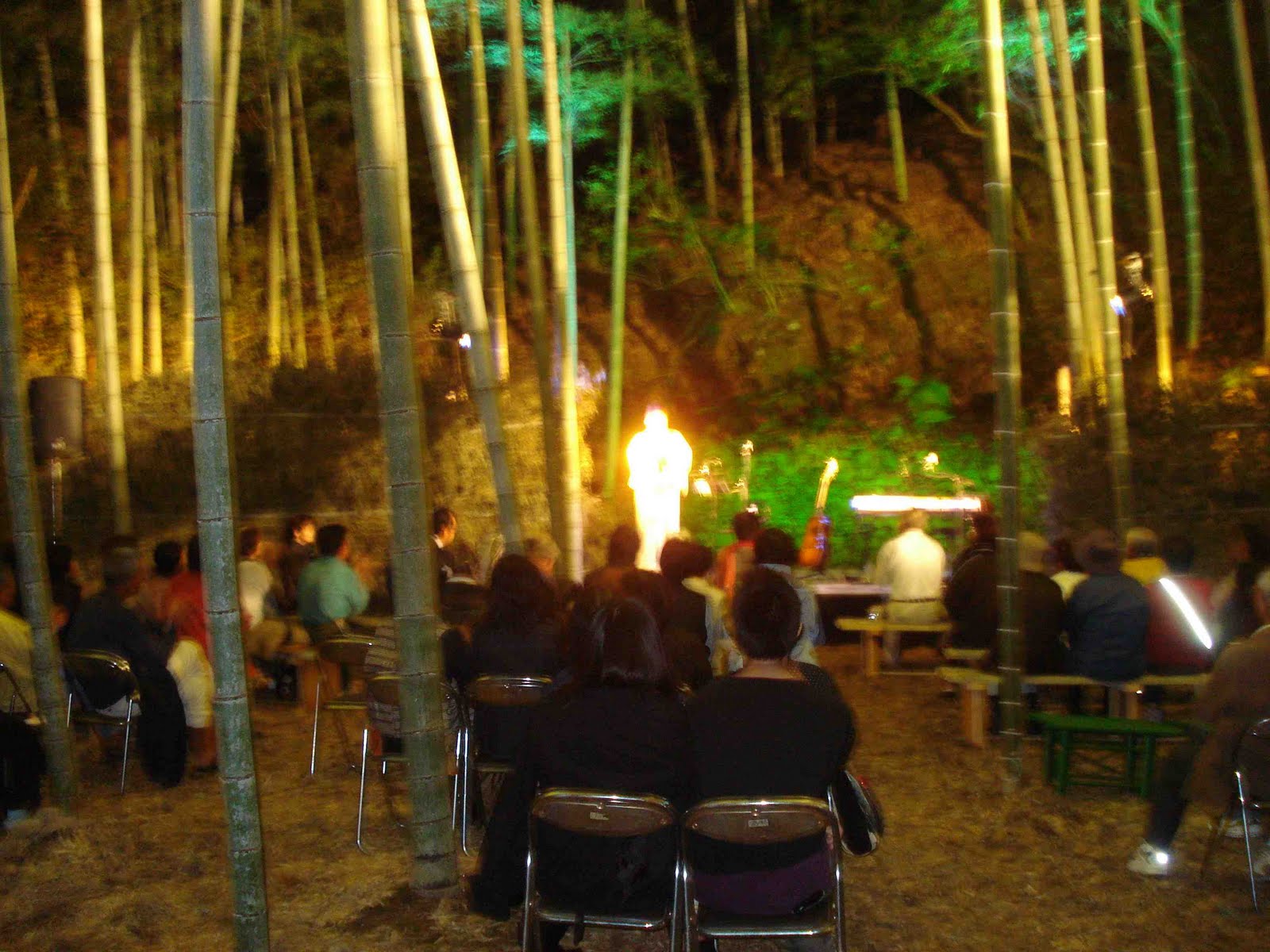
The night of Halloween this year was very different from the last. Last year I hit the streets of Vancouver as Bob Ross, my favourite televised painter of the 1980’s, and had a hell of a time at the UBC’s various beer gardens (or ‘bzzr’ gardens as they are advertised on campus). I think October 31st, 2009 was the first Halloween that I did not celebrate in some way, shape or form. Instead of getting trashed on campus in a denim suit and admiring the numerous naughty nurses, police women and the like, I volunteered with Big Up to help launch a fairly sizable event, the Bamboo Concert.

About twenty minutes away from the centre of Akune is a nice neighbourhood by the name of Tashiro. I commute to Tashiro once a week to teach a class at Tashiro Elementary; with a total of nine students at the school, Tashiro has become one of my favourite school visits of the week. Tashiro is a very mountainous area and as such it is dense with bamboo forests, which are a wonder to look at on a morning commute. Big Up decided to showcase Japanese artists from across the country in a local spot as a way to highlight the beauty of the bamboo forest and accentuate the tranquility of a naturally serene setting. With a few well placed lights deep in the bamboo forest, a couple dozen handmade bamboo benches along with some Japanese pop, Enka (Japanese classical pop music) and ocarina (yes, ocarina), Big Up was able to gather nearly one hundred audience members for the Bamboo Concert. I was very proud to be a part of what was later called a complete success.

Bamboo Concert


Aside from my involvement with Big Up, I have been filling up my schedule with a number of other fun and exciting activities. At the end of October I was asked to judge an English speech contest for junior high school students. I was glad to accept the invitation and even more delighted learn later that I too would have the opportunity to speak as a representative of the Akune Board of Education (BOE) as well as the only foreigner in Akune. The prompt for my speech was predetermined by advisor at the BOE, Momokita-sensei: “Japan as I see it”. As my first writing assignment since graduating from university, this speech was somewhat of a pleasure to write. I did, however, have some difficulties starting, as always, and since I was to deliver the speech in Japanese it wasn’t the easiest piece to prepare. I ended up presenting a speech about my encounters with and impressions of Japan throughout my life-starting with my first origami class in Tom’s 1st grade class, to Karen’s raku firing, my first girlfriend, world history class, studying Japanese with Tashibu-sensei and finally coming to Japan-and how those experiences came to form the image of Japan as I see it.

My experiences in alternative schools writing, making art and truly putting my creative tools to the test, I felt that I had to express a little of that side of me in my speech. Since I was writing, I felt that it would be apt to use some of my creative writing skills (shout out to Mr. Nolet, you were in this speech). I wanted to use a metaphor to tie up my whole speech. I honestly want to use the mosaic metaphor: all the experiences I have had with Japan are what make up the mosaic that is Japan as I see it. I ran this metaphor by my supervisor, who vaguely understood the figurative conclusion that I was so desperately trying to articulate in Japanese, but in the end Shinsaka-san gave me the verdict that I thought he would:
“You mean a jigsaw puzzle? It’s like a puzzle, right? Just say puzzle. You have to remember one thing, you’re speaking to junior high school students.”
I would only find out later, from another source, that when said with Japanese pronunciation, mosaic is often associated with a popular brand of adult entertainment videos.
“[…]In a way, Japan as I see it is a living jigsaw puzzle, made up of all the experiences I have had, the people who I have talked to and the images that I have had in my head ever since I was a child […]”
The above is a rough translation of the clincher of my speech. I was very happy with how my speech was received by the audience; the gymnasium was barely a quarter full the day of the speech contest.

Speech Contest


Last week I went on a couple of independent study adventures in Akune. On Saturday I went to a pottery studio in Tsurukawauchi (a neighbourhood) with a few friends from Big Up and Akune Public Hospital and had a great time practicing one of my favourite forms of art in a whole new whole in a very special environment. With the skills I learned throughout elementary and middle schools in Karen’s ceramics class at Summit K-12 (for life) I was able to thoroughly enjoy myself last weekend at Warabe Kobo (Warabe studio). It was my first time throwing pottery in a while and the fact that we were using small, hand-powered wheels, which I had never used before, turned a fun Saturday afternoon at the studio into a true test of my ceramic skill. After we finished forming, trimming and glazing our pots, a phenomenal accomplishment for a two hour class, we all sat around and shared tea while the people of Warabe Kobo, a lovely family of potters, talked about my afro.

Warabe Kobo


Last Sunday I went to my first-and definitely not last-cooking class at Ms. Matsumoto’s house. Ms. Matsumoto is the mother of one of my friends in Akune, Shigehisa-san. Shigehisa-san owns Harmonican, a very chic restaurant that I frequent on the weekend for delicious lunches with local ingredients. Ms. Matsumoto lives in an amazing house right next door to Harmonican that I believe I mentioned in an earlier post.

I showed up at the cooking class-having just borrowed a must-need apron from Harmonican next door-and was greeted by the warm smile of Ms. Matsumoto. She led me through the fabulous wooden genkan (entryway) into a nice sit-down dining room, something my unaccustomed knees have been missing for almost four months now. At the dining table I introduced myself to the small class of young and middle-aged women and without a second’s delay the tea had been poured and the class was underway.

First, Ms. Matsumoto read carefully over the menu, our course material for the evening. The menu for the evening sounded great on paper: shiitake, kinoko, maitake and eringi shisosuki (four-mushroom hot pot); three side dishes, including a small cabbage salad, baked miso-stuffed shiitake and deep-fried peanut konjac; and for dessert, a soymilk pudding. The kitchen was a bit crowded, but with all the hands we had, we were able to whip the meal together, for seven people, in less than ninety minutes. I was not alone as I sat, more than satisfied, basking in the lingering aroma of mushroom soup at the beautiful dining table. It was interesting to work in another kitchen-as apposed to my kitchen counter that comes up just past my thighs-,see how other people store and prepare ingredients and of course it was a pleasure to enjoy the fruits of a collective culinary effort.

The genkan


Mushrooms with Ms. Matsumoto


A culinary collective


I would like to leave you with a gastronomically themed proverb:

医者と味噌は古いほうがいい。

Doctors and Miso are both best when aged.

Until next time.

Tuesday, October 20, 2009

The Sword in the Stone

Hello readers from across the pond.

Excuse my aloofness in the past few weeks. My weekdays are now full with both elementary and junior high school visits for English class; the initial phase of giving my self-introduction has just come to a close. I feel situated now, driving the winding the country roads to and from school. In a way I am blessed with a busy schedule that takes me to eleven schools in Akune and the smaller peripheral towns. It hasn’t even been three months and I feel more than confident on my commutes throughout the week. Who wouldn’t in a miniscule white Mazda. I have even gone as far as taking the occasional short cut, finding the more interesting nooks and crannies of the city.

I have also branched out in the area a bit in the past couple of weeks and visited places in Kagoshima I have yet to explore. This has all been possible due to the help of friends at the Big Up Non-profit Organization. Big Up has a small, quaint office adjacent to Akune Station, home of the Hisatsu Orange Railway. The office is the hub for numerous volunteer opportunities in Akune as well as a very unique hostel. The hostel is unique in that the rooms advertised are actually old train cars, hence the name, Big Up STAY-tion (get it, station, as in train), a very cool concept in my opinion. Since making the acquaintance of the head managers of the office on separate days at two different bars, the Big Up office has become a spot that I look forward to visiting at least once a week, either for drop in volunteer work, dinner or the occasional adventure.

Last week I visited Big Up and sat in on a meeting that covered the upcoming events in October. Since the meeting I have already made chairs out of bamboo for the office and incoming quests and fired up a barbeque multiple times for road tripping families and Harley-Davidson riding he-men, and that is only the beginning. After the meeting that night, however, I was invited on an adventure. One the guys at Big Up, Mami-san, asked me if I liked hiking and if I wanted to come climb a mountain in with a couple of friends this coming weekend. I was humbled, happy and took no time to hop on the opportunity. I went home that night with my imagination running wild about what the weekend might bring, except I forgot to ask Mami-san where exactly we were going, all I knew was that it was going to be chilly and that I needed hiking shoes or shoes with plenty of grip.

It’s hard to work any job with a mountain climbing adventure looming just a few days ahead. This is what I thought to myself as entered class on Tuesday, Wednesday, Thursday and finally, at last Friday. I paid a visit to Big Up on Saturday, the night before the hike. Since I was on my way home from grocery shopping, I couldn’t say I was upset by the fact that I had walked in on a sukiyaki (beef, vegetable, amazing hotplate family style feast) party. As I kicked back on the tatami mats and drank in the warm atmosphere of new friends, newer acquaintances and, of course, my fair share of sukiyaki, I had another one of those, ‘man am I in the right place at the right time, again,’ kind of moments. Despite the slight sukiyaki daze that, I needed to keep my eye on the prize, the hike the following day. By the end of the night I learned from Mami-san that our hiking destination was well far away from Akune and that we all needed no gather at the Big Up office early in the morning, 0700 hours sharp. We were heading to 高千穂峰 (Takachihonomine) in Kirishima.

Whether it was my usual morning daze or my slight sukiyaki hangover, I am not quite sure, but what ever helped me survive the two hour car ride cramped in the back of an old Toyota sure did the trick. I started to come to when the landscape changed from flat rolling country hills to switchbacks and mountain roads. The smell of the air was different, rotten eggs. Sulfur, of course. We were getting close. Kirishima is known for it’s volcanic mountains and thus famous for it’s spectacular onsen (hot spring) getaways. Looking out the window through that arching branches of the vibrant red pine (赤松、aka-matsu) I could see natural spouts of steam emerging from the forest, filling the air with fast-disappearing clouds of white and that recognizable, pungent stench of sulfur.

It seemed as though we were never going to clear the tree line until we turned the corner right into the parking lot from where we would depart on our hike. There were five men in the group that day and five tired men made it back safely at the end of the day (sorry to ruin the potential for excitement). As we embarked on the hike I found myself shoulder to shoulder with Mami-san, receiving an historical lesson in thick Akune dialect about the site of the day’s hike. From what I gathered Takachihonomine is a very notable destination in Japan for many reasons: the very first honey moon in Japan occurred on this mountain; there used to be a shrine at the base of the mountain that was destroyed by a volcanic eruption a thousand years or more ago; and it is a beautiful and friendly hike. The most interesting aspect of Takachihonomine, however, Mami-san saved for last. Takachihonomine was where Japan all started, the point from which the land of the rising sun came to be. Thousands and thousands of years ago the sun goddess and a principal Shinto deity, Amaterasu Omikami, descended from…well…the sun. It is said then that with the force that only a sun goddess can truly posses Amaterasu Omikami thrust a sword into the Earth and from that point Japan emerged. And if you go up to the summit of what is now know as Takachihonomine, you can see for yourself the sword, but no matter what strength you may come with, it is impossible to remove the sword from the grips of the Earth. I guess Amatersau Omikami never met King Arthur.

Takachihonomine Ridge


With that extremely motivational historical lesson still lingering fresh in my mind, I steadily scaled Takachihonomine’s volcanic slopes, taking extra time to look at the deep red, brown and black colours of the rocks beneath my feet. I glanced behind my shoulder ever ten paces or so to check out the scenery. The immediate view was a vast forest of red pine in every direction over surrounding hills, mountains and winding in between villages. In the distance the faint silhouette of Sakurajima helped maintain my sense of direction, however much it distracted me from my actual progress up the mountain.

In a little over an hour I caught the first sight of the Japanese flag waving in the wind, the one I had seen all the way from the parking lot, with strong binoculars. And as I rounded the last boulder I could finally make out the faint shape of a sword, sticking right out of the very top of the mountain. It was a thrilling summit. After the whole team reached the top we all took a walk around the peak and found a nice spot to break open our bento and dine in the clear, crisp air; it was chilly that day; and I decided to wear shorts.


I never felt more satisfied from a convenient store-bought bento and as I looked around and surveyed my hiking team, I had a feeling they might have been thinking the same thing. Before starting our descent, we all gathered in front of the sword in the stone to take a commemorative picture. As always there is bound to be someone left out of the picture so I volunteered to take the follow up shot of the group. When I turned my back to the beautiful view to take the picture of my crew I heard something that nearly took my breath away:

“Asher!” in perfect, native English.

I turned around and saw Eli, a fellow JET participant from the Minami-Satsuma city. We had a brief exchange at the top of Takachihonomine, it even feels weird writing about it now. It is needless to say, but seeing Eli was a great way to start my descent, the beginning of the end of my trip to Japan’s earliest beginning.

I could have heard Mami-san’s story of Takachihonomine any number of times and only wonder at what awaited meat the top of that mountain. For all I knew, mami-san could have been tugging my chain. After all, though, as soon as I laid eyes on that sword, extremely weathered, yet still straight and steadfast in rock, I understood quite well how magnificent beginnings can truly be and how humbly we look back upon them:

百聞は一見に如かず (hyakubun wa ikken ni shikazu)
Hearing something one hundred times can never compare to seeing it even once.


Until next time.


Dinner:

Salmon


Eggplant


Chipotle chicken

Sunday, September 27, 2009

Hit the highways, it’s Silver Week

Hello all.

This past week’s multiple-day holiday was something of a rarity in Japan. Falling every year at mid to late September, Silver week, the shinier, (and in my opinion) more appealing relative of the spring holiday Golden Week, is much like the mysterious mid-winter break that is observed religiously and with great joy by my mother and her cohorts in the Seattle School district. Silver Week is composed of two holidays: Respect for the aged day-some people say that Silver Week got its name from the silver coloured hair of the people that the holiday commemorates; and the Autumnal Equinox. Interestingly enough, these two holidays are separated by one day, a void that the Japanese government graciously granted to the nation as Citizen’s Holiday. Usually this annual string of holidays begins on Saturday, leaving Monday as the only weekday vacation time for Japanese people all across the country to, well, go all across the country. However, this year Silver Week began on a Monday, resulting in a five consecutive days of vacation that is expected to occur a mere twelve times in the next ninety years. Yes, the stereotype of the Japanese as diligent workers does come from somewhere. I am indeed impressed and often times humbled by how well my co-workers and colleagues at school perform. However, I must say, that when the entire nation is set loose for Silver Week no time is wasted in taking advantage of a blank agenda.

My sights were set on South Korea. A good South Korean friend of mine from my days at Ritsumeikan University (Rits) in Kyoto had just returned home to Seoul so I thought that Silver week would be a perfect opportunity to pay her a long overdue visit. At this time of year, airfare to Korea from Fukuoka airport is far cheaper than, say, a trip by plane to Tokyo, unbelievable, right? After some thought and a quick conversation with my friend, though, we both decided that the five days was too narrow a window to do a legitimate trip to South Korea. With the thought of visiting old friends still fresh in my mind, I did not hesitate to start researching the best way to get to Kyoto. Before Silver Week it had been almost exactly two years since I touched down in Japan to start my year abroad in Kyoto; it was about time to return.

I was amazed at how expensive the Shinkansen (Bullet Train) fares from Fukuoka to Kyoto were so I sought out the means of travel I knew best, the night bus express. After making my reservation online I proceeded to the convenient store to pick up the hard copy of my ticket. Yes, you read it right. I picked up my bus tickets at Family Mart (a 7-11 style store) at the electronic machine right in between the disgustingly graphic cartoon pornography and the ice cream cooler. With the touch of a button, the drop of some bills and a bow at the waist I was on my way to Kyoto. I left my apartment on Saturday the 19th just a couple minutes past five o’clock, thus started my fifteen hour voyage to the former capitol of Japan and my former home.

Before catching my 2100 night bus I had to make my way north to Kumamoto Prefecture’s capitol city of Kumamoto, a former castle city. First I took the Akune’s infamous Hisatsu Orange railway to Izumi city. A trip on the Orenji, as it is referred to by locals, takes you for nice slow ride through the countryside in a one-car train, constantly packed with commuting students either gabbing about social happenings, slathering make-up on their faces or, the most popular, sleeping with mouths wide open. From Izumi city I took a short Shinkansen ride to Yatsushiro, the city where my dear friend Daniel Norton (another Rits acquaintance) worked as an ALT for two years. Since the new Kyushu Shinkansen is not completed as of yet, passengers bound for Kumamoto city must transfer to a relay express train. The system is pretty seamless, actually. When I lifted my head up after doubling down to get out of the Shinkansen there, just across the pristine platform, was my express train waiting just for me, and hundreds of other vacationers. As the sunset in a cloudless sky behind the tile roofs of Yatsushiro city I basked in the reassuring and accomplished feeling of catching a connecting train.

It was already dark when I arrived in Kumamoto city. I took a long walk along the local train line to the bus station where my night bus was waiting; I had two hours to explore Kumamoto streets in search of food and beer; aside from stale air, stale bento and fuel, beer is up there on the list of consumables aboard a cross-country night bus. I wanted a somewhat of a simple meal so I walked into one of the first noodle houses I saw.

I don’t eat ramen much, but I was on the verge of conversion after I took the first spoon-full of soup to my lips. I order a black sesame ramen. The soup was, you guessed it, a deep, dark colour, almost reminiscent of gunmetal and looked like the consistency of motor oil, appetizing, right? The soup had such a rich flavour and the small sesame granules added a very pleasing texture to what I expected to be the usual watery broth. With my hunger satiated and teeth tinged black with sesame I chatted with the master of the ramen house over a cold bottle of Asahi beer. It was time to catch my bus. I was pleased to discover that my seat reclined almost all the way back. However, I soon realized that the backward reclining freedom would be at the cost of precious legroom.

The night bus experience is like none other. The blinds of the bus are closed all throughout the night. The liberal air conditioning makes you squirm and reach desperately for more of your blanket that just isn’t there. The bathroom, sunken into the middle of the cabin as if it were some sort of trap, is miniscule even to the most petite persons. In the midst of constantly interrupted sleep your joints slowly loose their range of motion, your eyes become nocturnally acute beyond explanation, the roar of the bus and cars on the highway vanish and the space around you becomes void, the surrounding passengers complete enigmas.

“Good morning everyone, we will soon be arriving at our final destination, Kyoto Station.”

I felt such a wonderful rush walking through the crowded innards of Kyoto station. Passing by the packed restaurants, the seemingly endless train ticket lines and the sheer number of people, Japanese and foreign travelers alike, made for long awaited, cacophonous homecoming. I strolled out of the main exit and my instincts kicked in. Without thinking I found my place in line at the 26 bus stop headed for the northwest of the city. The slow ride through the crowded and bright morning streets of Kyoto was just what I needed after perplexing night bus adventure.

At last, the bus reached the Utano Youth Hostel stop. My travels were over. As I shouldered my backpack, roller bag clunking after me in a graceful dismount from the bus, a smile formed across my face, ear to ear. I ducked under the metal gate of Ritsumeikan International House II (I-House II) and walked with my chin high and chest full of pride down the driveway to the card key entryway. There on the other side of the glass door, waiting for me as promised, was Kuri-san, dear friend and fellow student at Rits. When the door was swung open I said the greeting that I had planned on saying since the day I left I-House II nearly a year and a half ago: “Tadaima (I’m home).” And to my great joy and appreciation, Kuri-san responded with, “Okaerinasai (Welcome home).” Kuri later told me that he had planned on greeting me so and that he only saw it appropriate.

It was, to say the least, a trip walking through the hallways of I-House II. I was honestly expecting a cathartic return, but I soon realized that I was surprisingly at peace at the sight of all the dorm rooms filled with a different mess of clothes, the first floor hallway lined with last year’s worth of junk (ie. my new calligraphy set, score) and the kitchen crowded with jetlagged bodies and the aroma Japanese renditions of world cuisine.

Over the next few days I visited my favourite places and people in Kyoto, all the time dodging tourists left and right; I have honestly never seen so many shoulder shrugs, furrowed eyebrows and fanny-packs (yeah, that’s right Dad) as I did last week in Kyoto. On the day I arrived I took a nostalgic (understatement) stroll through Rits’ campus, ate at my favourite teishoku (set menu) restaurant-and ran into some Japanese exchanged students form UBC-walked the zoo-like sidewalks of downtown Kyoto and made a truly spiritual pilgrimage back to the sacred Satonoya Yakiniku (Korean barbecue) restaurant where I reunited with three great old friends from my Rits days and delicious cold Yebisu beer with all the beef, rice and kimchi you could handle in 90 minutes.

Monday seemed like it was going to be even more crowded than the day before, considering the 21st was when the actual holiday started; enough fanny packs already. Accordingly, Kuri and I hoped a train to the town of Yamazaki to take a tour of the Yamazaki whisky factory. To make a long, delicious, deeply aromatic and emotionally moving-with a free Yamazaki rock glass-story short, Yamazaki whisky factory was a Monday afternoon well spent. In the evening, that is after the whisky buzz had started to fade, I met up with Akira, old friend and owner of Rakuraku home kitchen, for some yakitori and some awesome chocolate cake and coffee at a machiya (literally, town house +100 year-old house)-turned French café. Akira is one groovy dude. He lives a life full of love, love for food, love for music and love for people who are involved in either.

The morning I left Kyoto I had a plan to meet with a group of my old Japanese teachers that taught me while I was a student at Rits. It was such a pleasure to see them again, and what’s more, almost all of them showed up. For the better part of two hours five of my old Japanese teachers and I shared coffee, stories of the past year and of course of the past few months I had spent in Akune. It goes without saying that I have a newfound respect for educators everywhere (Mom, Barbara, Ms. Tashibu and the rest, kudos just do not suffice).

I spent the last hours in Kyoto with Kuri catching up on the last year of our lives; Kuri had spent the last year in China on exchange and told me some pretty amazing stories, the one about how the Chinese government makes it rain when necessary was particularly intriguing. I want to thank Kuri for letting me sleep on his floor, taking me out to the whisky factory and sending me off all the way to my bus at Kyoto station. Thanks Kuri, I’ll see you again this year.

“Good morning everyone. Are you tired? We will soon be arriving at our final destination, Kumamoto bus terminal.”

I really enjoyed the Shinkansen ride from Yatsushiro back to Izumi. Let me tell you why: usually the Shinkansen attendants are robotic and do not smile, nor do the make eye contact with the passengers. As I gazed out the window, glossy-eyed and dreary, wondering, ‘How can JR (Japan Railways) sacrifice service for personality?’ a dashingly handsome attendant entered my car; he turned and faced the passengers with such precision and at gracefully slow pace; his uniform was immaculate. As the attendant rose, again very slowly, from his bow, I saw the smile that I had been wondering about just moments ago, my doubts about JR vanished. When he took my ticket he made eye contact and thanked me for my service in a refreshingly crisp voice. What a nice ride home on yet another cloudless day.

I would like to leave you with a poem, rather than a proverb. There is always a beautifully handwritten poem outside of this temple (whose name escapes me now) up the street from I-House II. The poem changes every month. I saw this haiku as the 26 bus hauled up the road from I-House II on my way back to Akune last Tuesday night:

曇りなき
心にできぬ
ことはない
(kumorinakikokoroni dekinukotoha nai)
At a glance I translated this poem as follows: A cloudless heart is capable of anything. However, after getting all the way home to Akune I found a message Kuri had sent me, correcting our interpretation:

If one can do what one believes in without doubting oneself, anything can come true.

Until next time.